








Personal Shopping List
The following plants have been added to your shopping list. You can continue to browse our plants to add more plants, or you can generate a printable version. Homeowners, please bring in your print out and we'll help you find the plants you have selected. Landscapers who purchase from the Prairie & Wetland Center can attach this list to help differentiate your proposal from your competitors.
|
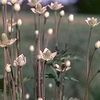
Anemone virginiana
Common Name: Candle Anemone
White flowers have four to nine "petals" (sepals) located on an elongate flowering stalk. Fruit elongate (1 to 1 1/2 inches in length). Numerous leaves are roughly divided into three main parts. Occurs on dry soils and open slopes.
|
Height: 24-36 Inches
Spread: -12 Inches
USDA Hardiness Zone: 3-5
|
|
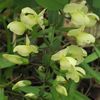
Baptisia leucophaea
Common Name: Cream Wild Indigo
This is a fairly low growing native plant which is easily spotted in the late spring growing along roadside prairies and open woods. The gracefully arching, creamy yellow horizontal flower stalks are unmistakable. Leaves and stems are finely hairy. A single stem arises from the ground then becomes multi-branched. Flowers are pea like and borne on stalks running more or less parallel with the ground.
|
Height: 12-30 Inches
Spread: 12-36 Inches
USDA Hardiness Zone: 5-9
|
|
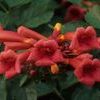
Campsis radicans
Common Name: Trumpet Creeper
Hummingbirds find this plant irresistable! They feed on nectar produced by clusters of orange-red trumpet-shaped flowers from July-September. This woody vine attaches to any surface with rootlike holdfasts. Lustrous dark green leaves form a good screen. Can be quite aggressive so plant it where it will not compete with other plants.
|
Height: 20-40 Feet
Spread: - Inches
USDA Hardiness Zone: 4-9
|
|
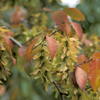
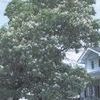
Carpinus caroliniana
Common Name: American Hornbeam
A very handsome small to medium tree with multiple stems that forms wide, horizontal canopy. Dark green leaves can be yellow, orange, red or purple in fall. Beautiful thin, blue-gray bark. The seed is eaten by songbirds, quail and turkey. Whitetail deer will browse the twigs and foliage. Known as one of the strongest and densest woods of our forests, the wood is used in golf clubs and various handles.
|
Height: 20-40 Feet
Spread: 20-50 Feet
USDA Hardiness Zone: 3b-9
|
|
Catalpa speciosa
Common Name: Northern Catalpa
Northern Catalpa is a medium to large, deciduous tree that typically grows with an irregular, open-rounded to narrow-oval crown. It typically occurs along streams, bluff bases and in both low and upland woods.Large, broad oval to oblong leaves are light green to yellow green above and hairy below. Foliage turns an undistinguished yellow in fall. Flowers can be a real showstopper, however. Bell-shaped, orchid-like, white flowers (to 2" long) with purple and yellow inner spotting appear in panicles in late spring. Flowers are followed by long, slender, green seedpods (12-22" long). The seedpods mature in fall to dark brown and then split open lengthwise to release the seeds within. Seedpods give rise to the common name of cigar tree. Bark of mature trees is fissured, prominently ridged and pale gray-brown.
|
Height: 40-70 Feet
Spread: 35-50 Feet
USDA Hardiness Zone: 4-8
|
|
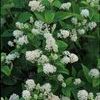
Ceanothus americanus
Common Name: New Jersey Tea
A slow-growing, compact shrub that's excellent for hot, dry sites and for atttracting wildlife. Billows of delicate white flowers in May and June attract butterflies, insects and hummingbirds. Clusters of small black fruit form in July and August.
|
Height: 36-48 Inches
Spread: 36-60 Inches
USDA Hardiness Zone: 4-8
|
|
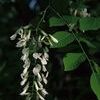
Cladrastis kentukea
Common Name: Yellowwood
An excellent, medium sized specimen tree, with light green compound leaves turning gold in fall. Spectacular 8-14" long panicles of fragrant, creamy-white flowers bloom in May and hang down from the branches. The bark is very smooth and gray. This is an underused, beautiful native tree.
|
Height: 30-60 Feet
Spread: 40-55 Feet
USDA Hardiness Zone: 4-8
|
|
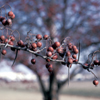
Crataegus crusgalli
Common Name: Cockspur Hawthorn
A small tree developing a flattened crown with long horizontal branches. Clusters of white flowers bloom for 10 days and are followed by deep red berries that persist into late fall or winter. The fruit is great for wildlife food and the 2-inch thorns provide great protective cover. Great for a protective barrier planting. The hawthorn is the state flower of Missouri.
|
Height: 20-30 Feet
Spread: 20-35 Feet
USDA Hardiness Zone: 4-6
|
|
Gentiana andrewsii
Common Name: Bottle Gentian
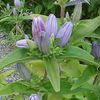
Best grown in moist, rich, acidic, well-drained soils in part shade. Dislikes hot nights. If left undisturbed, plants in optimum growing conditions will naturalize over time into large clumps. Typically grows one to two feet tall. The name comes from its tight clusters of tubular (bottle-shaped), deep blue flowers which never open. Flower clusters appear at the tops of the stems or in the upper leaf axils in late summer to early autumn. Ovate, lance-shaped leaves to four inches long have parallel veins.
|
Height: 12-24 Inches
Spread: 12-18 Inches
|
|
Mimosa microphylla
Common Name: Sensitive Briar
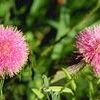
This interesting species can be found throughout the southeastern United States. The plant is easy to identify becasue of its pom-pom inflorescences, prickly stems, and sensitive leaflets. The leaflets fold together immediately after being disturbed and usually unfold about 3-5 minutes later. Widespread and abundant from May through September, on roadsides and in open fields.
|
Height: 12-18 Inches
Spread: 12-18 Inches
USDA Hardiness Zone: 5-9
|
|
Pontederia cordata
Common Name: Pickerel Plant
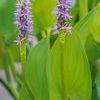
The blue-violet flower spikes of this hardy water plant stand out at the edge of a pond or in a small pool from June through October. Large stands make a very showy statement. Glossy green, lance-shaped leaves grow vertically out of the water.
|
Height: 18-24 Inches
Spread: 18-24 Inches
USDA Hardiness Zone: 3-11
|
